
I’ve been following the AI debates for many years: on the one hand those arguing that AI is just another powerful technology, that sure, it’s going to have a big impact, but not unlike previous technological revolutions; and on the other hand those arguing that AI is unlike anything else, and that it could literally destroy the world.
I’ve generally found the exceptionalist arguments more convincing, but also have a lot of sympathy for the skeptics. I admit I’ve even enjoyed the debate, and had a good time reading books like Superintelligence: Paths, Dangers, Strategies and If Anyone Builds It, Everyone Dies: Why Superhuman AI Would Kill Us All. Intellectually I knew this was important, but my brain struggled to create an emotional response to something that felt so theoretical.
Over the past few months, as I watched many of the scary predictions about AI become a reality, my feelings finally caught up. I found myself filled with existential questions:
- Might AI really kill us all?
- Will there soon exist smarter-than human AI that renders human labor largely obsolete?
- Will this be the last decade where my intellectual work has meaning?
- Am I spending my time on problems that will ultimately not matter much?
- Or am I just being distracted by end-times thinking and FOMO?
I’ve also found myself thinking about my students and other young people who are just starting life and need to navigate personal and career decisions in such stressful times. As I considered my own decisions, I thought about what advice I should give them. Stressing my students even more seems irresponsible, but so does telling them that everything will be fine and they need not worry about these questions.
This post is my attempt to give good personal advice for the moment we live in, focusing mainly on career decisions. As far as I can tell, none of the ideas I present are original.
How much is AI going to change the world?
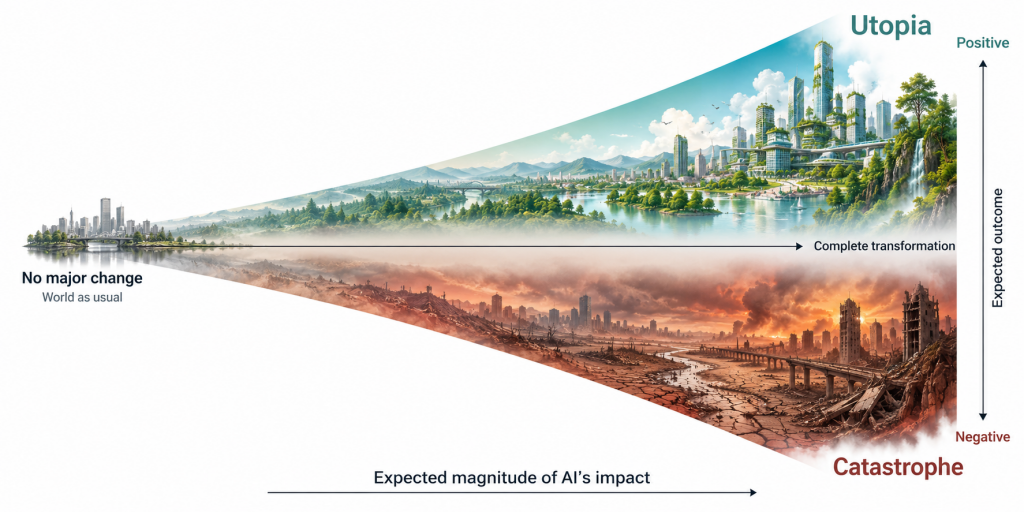
Evidence is piling up in favor of those predicting profound change, but there’s still wide disagreement among experts. You can find the full range of opinions, from domain experts who believe that despite all the hype not much is going to change, to thinkers who believe that the amount of change we are going to witness in the next decade will exceed that of all prior human history. There’s also the question of whether the change will be positive or negative.
(Source: ChatGPT)
The most outspoken skeptic is Yann LeCun, who won the 2018 Turing Award for his contributions to deep learning. In April he said: “AI sucks, […] We have systems that can manipulate language, and they fool us into thinking they are smart”.
On the side warning from a looming catastrophe you can find people like Eliezer Yudkowsky, Yoshua Bengio and Geoffrey Hinton (Bengio and Hinton shared the same 2018 Turing Award with LeCun). In a recent BBC interview Hinton said that a 10% chance of AI killing all humans isn’t an unreasonable estimate.
And then on the utopian side you will find quotes from AI industry leaders like Demis Hassabis (CEO of Google DeepMind), who said last year: “I think one day maybe we can cure all disease with the help of AI […] maybe within the next decade or so, I don’t see why not”.
Interestingly, the people who believe in an AI utopia tend to be the exact same people who worry about a catastrophe. The real debate is between the skeptics and believers in profound change. The crux of the debate is whether AI is a “normal technology”. What are each side’s best arguments?
Let’s start with reasons to be skeptical of the world completely changing within a decade. First, predictions about the world as we’ve known it coming to an end are really not a new thing, with notable examples in most religions. Somehow people always believe that an unprecedented transformation is coming within their generation, but these predictions have a very poor track record. Revolutions and big transformations sure happen, but they tend to be much more limited and slower than people imagine.

(Source: ChatGPT)
Speaking of poor predictions, Geoffrey Hinton famously said in 2016: “People should stop training radiologists now […] It is just completely obvious that within five years deep learning will do better than radiologists”. As of 2026 radiologists are still doing very well and are paid more than ever.
Economists also tend to be very skeptical of claims that a technology could lead to double- or triple-digit annual GDP growth. It is one thing to solve mathematical and coding challenges in the digital world (as impressive as that is), and another thing entirely to integrate a technology with supply chains and the messy physical world.
The opposite side acknowledges all of that, and yet insists that AI will do what no other technology has. What are their best arguments?
First, AI is the only technology that has the potential to completely replace us.
When I watched a total solar eclipse for the first time, one of the things that left the strongest impression on me was how radically different a total eclipse was from the 99% one I had seen just seconds earlier. A 99% eclipse looks a lot like no eclipse at all: you can’t really see it with the naked eye. There’s a whole class of phenomena like that. Accelerating a particle from rest to 99% the speed of light takes less energy than taking it from 99% to 100% (which would require infinite energy and therefore impossible for any particle with mass). I could give many other examples.

(Source: ChatGPT)
Similarly, with 99% automation things would be a lot more efficient, but the remaining 1% would soon become the new bottleneck of the economy. With 100% automation, on the other hand, human labor would stop being a bottleneck for anything of consequence1 and the economy would basically run and grow itself.
Another important difference between AI and all other technologies is that it has agency and creativity. Fire, engines, electricity and nuclear energy are all transformational technologies of enormous power, but we understand them at a level where we expect no big surprises, and can therefore control them. AI is already behaving in surprising and poorly understood ways, and it seems very plausible that the problem will only get worse.
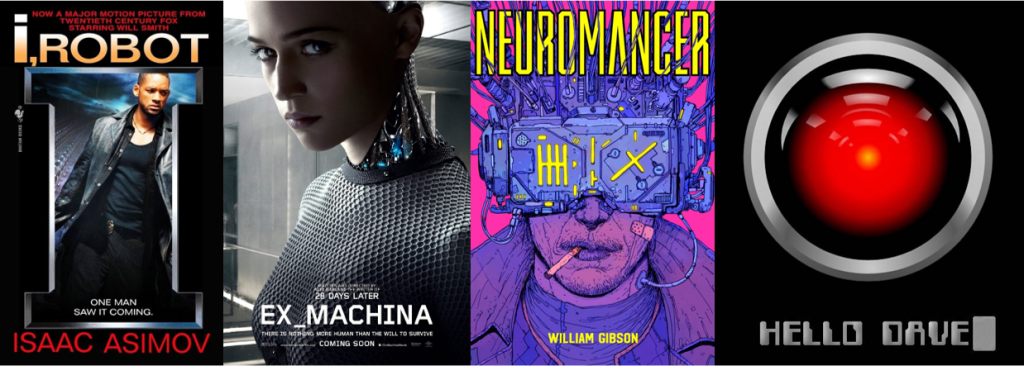
Finally, the idea that AI can radically change the world, and could potentially get out of control and harm us, is just common sense. The fact that so many sci-fi books and films have predicted this is, in my opinion, more an argument for than against that claim.
(Source: not ChatGPT)
These predictions and fears go back a very long time. Alan Turing himself wrote that a thinking machine “may be used to help in making up its own programmes” (Computing Machinery and Intelligence, 1950), that “once the machine thinking method had started, it would not take long to outstrip our feeble powers”, and “At some stage therefore we should have to expect the machines to take control” (Intelligent Machinery, A Heretical Theory, 1951).
The right attitude is uncertainty
I take all these arguments, both for and against AI transformation, very seriously. I see good reasons to think that reality will eventually discipline those making extraordinary claims, and good reasons to think that it really is going to be different this time. In fact, there are so many variables and unknowns that I’m quite suspicious of people expressing too much confidence in either direction (which doesn’t change the fact that they may turn out right).
I therefore argue that the only sane attitude is (at least some amount of) uncertainty. I advocate for uncertainty about the whole thing: where AI is going, its impact on the world, and the timeline of change.
Being uncertain is not the same thing as having no opinion, and it’s more useful than it sounds. It’s definitely not a license to cherry-pick and act on whichever opinions sound the most pleasant. Being uncertain should make you more cautious, not less.
Decision making under uncertainty
Thankfully there’s a vast literature on decision making under conditions of uncertainty. If you join an MBA program, you’ll take entire classes on the topic (on the rare occasions you are not skiing or surfing at nice resorts).
Some advice I find helpful for the present moment:
- Look for robust plans and actions. In particular, avoid actions (or inactions) that would be disastrous under scenarios you deem plausible. For example, I would advise against neglecting your personal growth under the assumption that none of it is going to matter because AI will soon replace us. Likewise, I advise being critical of claims that we don’t need to do anything to safeguard against dangerous AI.
- Don’t change plans too often, but be prepared to pivot sharply. It’s very possible there will come a time when progress in AI renders some of your current plans obsolete. Be willing to accept that, but don’t rush to conclusions on insufficient evidence.
- Don’t be seduced into overconfidence. A Jewish proverb says there’s no joy like the resolution of doubts, but don’t be tempted to resolve your doubts prematurely. Be suspicious of influencers who sell you simple narratives.
- Try to be informed on what’s happening. Look for diverse opinions, and take all advice with a grain of salt (yes, this one too). Most discourse is toxic and worth tuning out; focus on sources of information that respect your intelligence and genuinely seek to inform you. Don’t obsess over things you have no control over.
- Don’t frame your uncertainties as binary “whether or not”.
- Keep doors open, be agile.
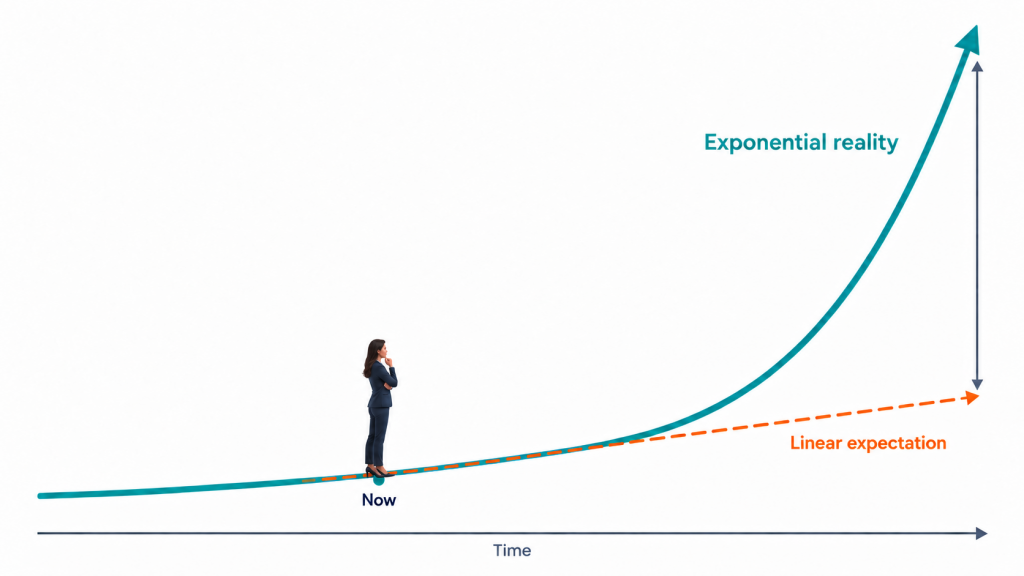
Another critical point is: don’t expect change to be linear. Things can change really fast. Two years ago most mathematicians thought chatbots were nearly useless, and now their entire field is in disarray. I’m amazed by how many organizations think of “AI strategy” as responding to the current generation of AI models, without spending any time thinking about how AI capabilities could radically change in another 1-2 years. Be smarter than most C-suite executives.
(Source: ChatGPT)
Okay, but what specifically should I do about AI?
I obviously don’t know your specific circumstances. I’m struggling to make sensible decisions even for myself. But there are a few things I think are useful for almost everyone in any profession.
First, learn to use AI tools to do valuable work. For example, spend at least 10 hours trying to work with AI agents. I’m not talking about the version of AI that answers questions, but the agents that run longer tasks and can make things for you (software, reports, videos…). Knowing how to use AI won’t protect you from changes in the job market, but it can make you a bit more informed and competitive, which can give you more degrees of freedom to navigate transitions.
At the same time, practice thinking without AI. One harm of overusing AI, at least in its current form, is that it will often give you the illusion of making progress on a problem. It will happily apply generic tools to your problem, whereas what you really need is to pause and study it. AI slop is real. As one specific example, I recommend against using the current generation of chatbots to write job or school applications – you have no idea how generic they sound.
But the more profound danger of overusing AI is that we are all slowly losing our ability to think. Thinking is critical for the human body, like moving. If you told an average person from before the Industrial Revolution that many people in the modern world lift weights and run on treadmills, they would think it’s madness. After a long day of physical labor, the last thing a 1500s farmer needed was to burn more calories. But as the Industrial Revolution has relieved us of the need to do physical work, we found that not doing any physical activity is really unhealthy. So we have come up with somewhat artificial ways to use our muscles. A lot of cognitive work is similarly becoming optional, but it strikes me as a bad idea to completely opt out.
Another piece of advice is to focus your career on the things AI is still bad at, and likely to remain bad at for longer than other things. Right now it looks like AI is getting really good at tasks that can be accomplished in a purely virtual environment, over relatively short time horizons, and with quick feedback loops and verifiable outputs. In contrast, it’s still struggling with physical or in-person work, or with tasks that span long time horizons and require good judgment and taste.
Good judgment in particular strikes me as one of the most in-demand skills right now, and something you should demonstrate in your work. Many tasks – developing software, proving theorems, making images and videos – are easier than ever to complete. But someone needs to decide which tasks are worth pursuing in the first place. That someone should be you.
Many CVs I’m getting from candidates emphasize the programming languages they know: Python, Java, C++, R. Programming skills are not entirely obsolete just yet, but I worry these candidates are losing the plot. The main questions I ask when sifting through applications are: Would I trust this person’s judgment more than Claude’s and ChatGPT’s? Would it be easier to communicate with them? Would they learn faster than AI? When applying for a job, demonstrate you know how to make good judgment calls and have good taste in the domain you are applying in. Think about how you can cultivate these skills.
Focus on what you can control and be happy
Yes, none of these things will fully protect you, or any of us, if the world is really heading towards a complete upheaval. Ultimately we’re all in this rocking boat together, and it’s our collective responsibility to make wise choices. Focus your energy on the things you can control. And do things that make you happy.
- Some have made the argument that certain jobs, like priesthood, will always require humans by definition. I find it plausible, but don’t think it makes a difference for the key argument because these jobs are unlikely to be a bottleneck for the parts of the economy necessary for accumulating hard power. ↩︎